DJ Dog on screen: three columns, ten positions, ten fixed lines
DJ Dog is a small game that is easy to misread. It has 3 columns, not five, and the three columns do not hold the same number of symbols as each other. This site is about that shape and the interface built around it: where the lines run, what the counter means, and which button does what.
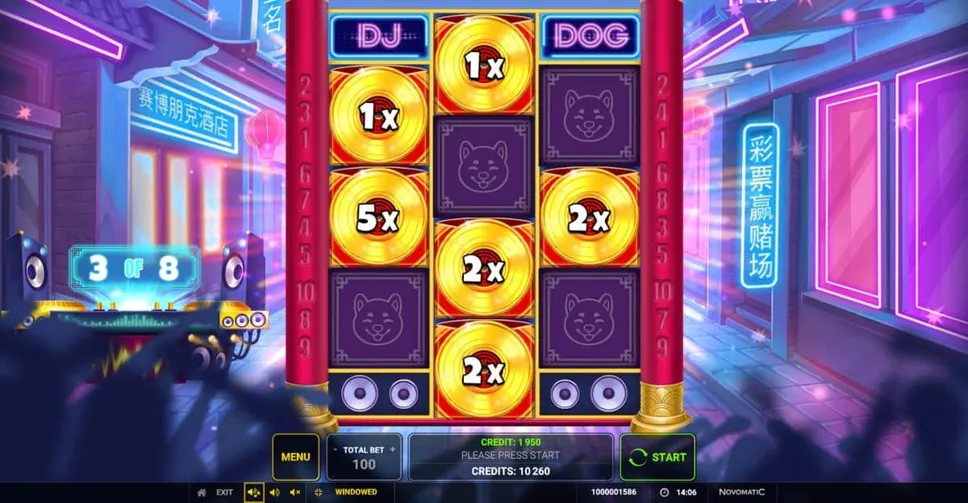
The screen
| Columns | 3 |
|---|---|
| Symbols down each column | 3, 4, 3 — 10 positions in all |
| Win lines | 10, fixed, left to right from the leftmost column |
| Feature length | 8 spins |
| Swing | four marks out of five on the studio’s own bar; pages written elsewhere word the same thing as high |
| Lowest stake | 0.10; a British licence caps a round at £5 |
| Built for | a browser on a computer and a browser on a phone |
| Studio | Greentube, part of Novomatic |
What you are actually looking at
The playing area is the middle third of the screen, framed by two red pillars. Everything outside them — the dog at his decks on the left, the shuttered street on the right, the speakers at the foot of the frame — is scenery. No symbol ever lands there, nothing in it changes a result, and none of it is a control.
That matters more on a small game than on a large one. When a grid has five columns the grid dominates the screen and there is no doubt where to look. Here the grid takes up less than half the width, and the rest of the picture is busy and lit and moving. The first useful thing to learn about this screen is which part of it is the game.
The second is that the grid is not square. It is often described as if it were, and it is not.
How the grid is actually shaped
Three columns, holding 3, 4 and 3 symbols from left to right. That is 10 positions, not nine and not twelve. The studio writes it as a 3-4-3 row slot on 3 reels, a catalogue entry lists the layout as 3-4-3, and an operator lobby describes it in the same words. You can also simply count them in the picture above.
This is worth being firm about because at least one widely read account of this game states a flat three-by-three grid, and a reader who believes that will be confused the first time a symbol lands in a fourth row. Where a number can be checked against the game itself, the game wins.
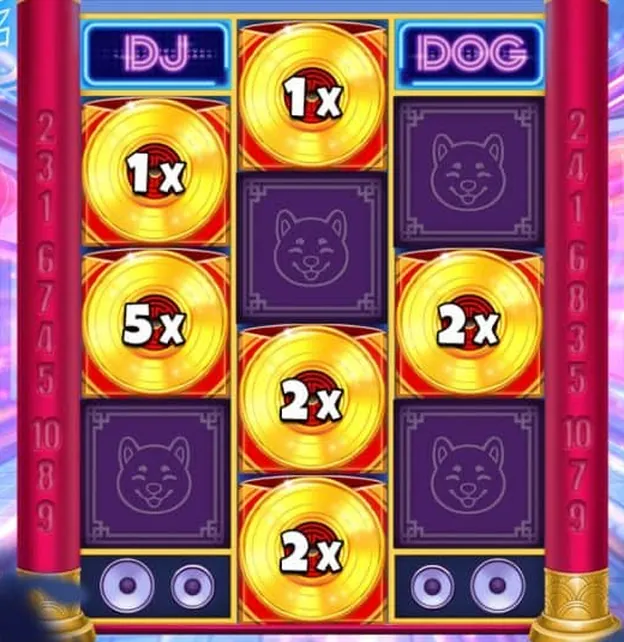
Paylines explained: ten of them, and none of them switches off
Ten fixed lines run across those ten positions. Fixed means exactly what it says: there is no control anywhere on this screen for turning lines on or off, so the familiar question of how many lines to play has no answer here because it is not a question the game asks. You set one figure — the total for the round — and all ten lines are live for it.
With only three columns, a line is three symbols and a win is a whole line. There is no partial match, no two-of-a-kind on a five-column grid, nothing to read halfway. Combinations run left to right from the leftmost column, so the leftmost column has to be part of any line win.
The lines are numbered down the two pillars that flank the reels, which is where a five-column game would put nothing at all. It is the one piece of interface this game puts outside the grid, and it is easy to mistake for decoration.
What the eight-spin round does to the picture
The feature is called Lucky Spins. It runs for 8 spins and it is not triggered by anything you do or by any combination you can see coming — it simply arrives on a base round, and the round it arrives on is the start of it.
What it does to the screen is unusually drastic for a feature. The ordinary symbols stop appearing altogether; only gold records and empty positions land. A counter lights up above the decks reading how far through the eight you are. The grid, the ten lines and the stake all stay exactly as they were, which is why this page treats the feature as a state of the screen rather than as a separate game.
Where the numbers live
Everything you can adjust sits in one strip along the bottom edge: a menu at the far left, the stake with a minus and a plus either side of it, a message panel in the middle carrying two figures, and the control that spins at the far right. Below that strip runs a thinner row of switches — sound, a windowed-or-not toggle, a way out, a session reference and a clock.
The clock is the one piece of that row worth noticing on purpose. A game screen is otherwise a room with no windows: nothing in the lighting, the music or the pace tells you how long you have been there.

What is settled here, and the two figures that are not
Everything above is settled. The grid, the ten lines, the eight spins and the platform list come from the studio’s own specification and can be checked against the running game. They are the reason this site is about the shape of the screen rather than about percentages.
Two numbers are not settled, and both are the numbers people usually come looking for. The return is the first. The studio does not publish one for this game — its specification lists game type, swing and platforms and nothing else — and the pages this site was rewritten from named none either. Outside pages print 95%, three of them independently, and so does at least one operator lobby. One of those pages phrases it as the studio having rated it so; that is the page talking about the studio, not the studio talking. The figure is theirs, it is worth knowing, and it is not this game’s published specification.
The maximum is the second, and it is worse. Three readings circulate: a reading of the game’s own rules panel gives a cap of 5,000x on the feature; a catalogue lists a top win of 10,000x; a British review states 2,500x in its verdict while its own feature section states the first of the three. The studio publishes no maximum either, so there is nothing above them.
Which leaves one honest instruction for both: the information panel behind the menu, in the copy you are signed in to, is the only place either number is written down by something that knows your build. Everything else — this page included — is reporting what other people wrote.
Who built it, and why two names turn up
Greentube built it. Novomatic is the group Greentube belongs to, and the group’s mark is printed along the bottom edge of the client itself, which is why part of the pages about this title file it under one name and part under the other.
Neither is wrong and there is no argument here: one owns the other. It is worth saying plainly because an apparent disagreement about who made a game is the kind of thing that makes a reader distrust everything else on a page, and in this case there is nothing to distrust.
Questions this screen tends to raise
How many reels does DJ Dog have?
Three. Not five. The studio’s own specification calls it a 3-4-3 row slot on 3 reels, and you can count the three columns in any picture of the screen.
Why does the middle column hold four symbols?
Because the layout is 3-4-3 rather than a flat rectangle. The middle column is one position taller than the two beside it, which gives the grid 10 positions in total and lets ten lines be drawn across only three columns.
Can I choose how many lines to play?
No. All 10 lines are fixed and there is no control on the screen for changing that. The only figure you set is the total for the round, and the stepper for it sits beside the menu at the bottom left.
What is the highest this game can pay?
That depends on which account you read, and they do not agree. A reading of the in-game rules gives 5,000x as the cap on the feature; a catalogue lists 10,000x; a British review prints 2,500x in its verdict and 5,000x in its own feature section.
The studio’s specification block does not print a maximum, so none of the three can be checked against it. Treat the number as unsettled and read the rules panel in the client you open.
What is the return on DJ Dog?
This site does not state one, and the reason is not caution for its own sake. The studio does not publish a return for this game — its specification block lists the game type, the swing and the platforms, and stops there — and the pages this site was rewritten from named no return either. There is no figure to pass on.
What exists is a figure other people print: 95%, carried by three independent pages about the game and by at least one operator lobby. One of those pages words it as the studio having rated it so, but that is the page speaking about the studio rather than the studio speaking, and it is not what the studio's own page says. A separate figure of 95.02% is quoted for the version with the feature bought outright, which Britain does not get.
So treat 95% as a number in circulation rather than as this game's specification, and read the information panel behind the menu in the copy you are signed in to. That panel is written for your build, and it is the only place the figure is stated by something that knows it.
Can I try the game here without money?
No. There is no copy of DJ Dog on this site, no window that loads one, and no link dressed up as one — the single outbound link is the operator button at the top of the page.
A free mode does exist for this title: one catalogue runs it, a British review page carries it behind an age check of its own, and a third account describes playing it hands-on. Whether any particular site or operator exposes it is their decision and changes without notice, so this page will not promise you one.
Six more pages follow the same screen in more detail, each one about a part of it: the grid, the lines, the feature, the character, the controls and the phone.
Carry on with
Start with the three columns if you want the shape settled first, or go straight to the ten lines for how a result is read.
The eight-spin round and the wild cover the two things that change what lands. The control strip and the phone layout cover what you press.